Snowshoe Hare in Denali
Overview
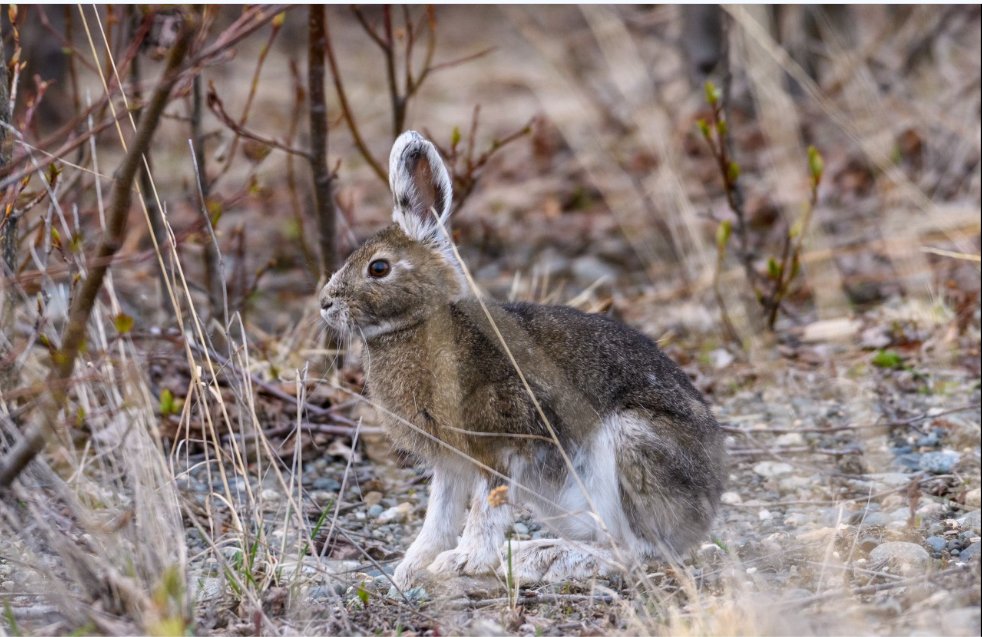
The snowshoe hare (Lepus americanus; family Leporidae), also called the varying hare or snowshoe rabbit, is one of two hare species in Alaska and the only one regularly found in Denali — it occurs throughout the Alaskan taiga, while the larger Alaska hare (Lepus othus) is restricted to the western coast ([1]; ADFG 2025). Two field marks identify it: oversized hind feet — the "snowshoes" that give the animal its winter mobility [3] — and a coat that swaps brown for white twice a year, leaving the hair white to the base and the ear-tips conspicuously black through deep winter (ADFG 2025). In Denali it occupies the boreal forest and the willow–alder thickets along streams and burns, traveling deeply worn runways that follow the same lines summer to winter (ADFG 2025). It matters out of all proportion to its size: snowshoe hare populations rise and crash on a roughly ten-year cycle, and lynx, coyote, marten, great horned owl, and goshawk populations rise and crash behind them [4]; [5]. When the rabbits go, the predators starve in their wake — a pattern Charles Sheldon already saw at the north base of Denali in the winter of 1907–08 [6].
1. Identification and Lagomorph Context
Alaska holds two species of hare and no native rabbits; the cottontails (Sylvilagus spp.) familiar farther south do not reach the state (ADFG 2025). Of the two hares, the snowshoe is the one a Denali observer encounters — it ranges throughout the taiga of Alaska [1] and is absent only from the lower Kuskokwim Delta, the Alaska Peninsula, and the area north of the Brooks Range (ADFG 2025). The Alaska hare, sometimes called the tundra hare, is a coastal western Alaska species of windswept slopes and upland tundra; it avoids forest and is roughly twice the snowshoe's mass, 22–28 inches and 6–12 pounds against the snowshoe's 18–20 inches and 3–4 pounds (ADFG 2025). The two species do not overlap meaningfully in Denali.
The Alaska population belongs to a single subspecies, Lepus americanus dalli. Hall (1981) recognized fifteen subspecies range-wide; Nagorsen (1985) found no taxonomic basis for the divisions because the cranial variation that defines them is clinal rather than discrete [1]. The Alaskan animal's nearest evolutionary affinities are not with circumpolar arctic hares but with the western American clade — L. americanus is more closely related to hares of the southwestern United States and Mexico than to the northern Arctic species (Halanych et al. 1999, in [1]). This is a useful corrective: the snowshoe is a forest hare that happens to live far north, not a polar specialist that happens to live in trees. Murie (1962), writing for Denali, gave the local subspecies as L. americanus macfarlani; this older designation appears to be the same lumped taxon Nagorsen later argued against subdividing.
Hares and rabbits share the family Leporidae but differ at birth. The young of true hares are precocial — born fully furred, eyes open, and capable of walking and feeding on vegetation within days; rabbits are altricial, born naked and blind in a nest (ADFG 2025; [1]). Snowshoe leverets weigh about two ounces at birth in an unlined depression called a form, walk by the time their fur is dry, and are eating green vegetation within two weeks (ADFG 2025). First litters in interior Alaska appear in mid-May, averaging four young; second litters in good years run larger, six on average, and a third litter is occasionally produced. Females breed again immediately after giving birth. The compounding effect of this reproductive schedule is large — three litters of four to six young, with each cohort breeding the following spring at a year old, is the demographic engine that drives the hare's capacity for rapid population growth and a peak density that can reach 600 animals per square mile in interior Alaska (ADFG 2025).
The field marks that separate the snowshoe from the Alaska hare are practical at any season. Summer snowshoes are yellowish to grayish brown above with white underparts and a brown-topped tail; winter snowshoes turn white but their hairs are dusky at the base and the underfur is gray, the ear-tips conspicuously black (ADFG 2025). The winter Alaska hare, by contrast, is pure white to the base of the hair with blackish ear edges and a wholly white tail — a cleaner white animal than the snowshoe, and a much bigger one (ADFG 2025). Confusion is unlikely in Denali because the Alaska hare does not occur there; the distinction matters mainly for travelers moving between the park and western Alaska coastal areas.
2. Habitat and Cover Use in the Boreal Mosaic
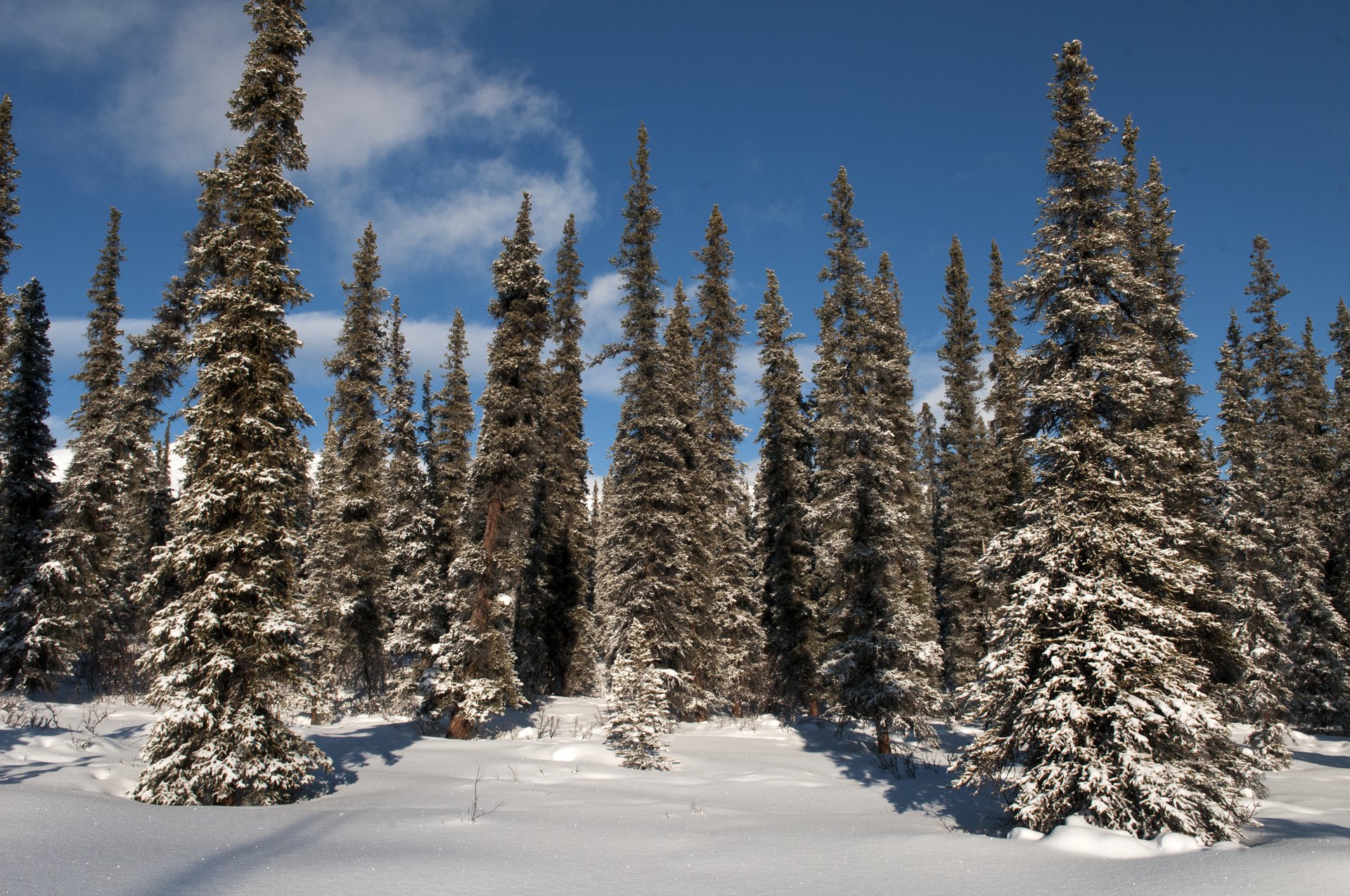
Snowshoe hares in interior Alaska are forest and shrub animals — what the literature calls a habitat of mixed spruce forests, wooded swamps, and brushy areas (ADFG 2025), or in MacDonald and Cook's broader formulation, forests, shrubby woodlands, and riparian shrub thickets [1]. The defining requirement is overhead cover at hare height, especially against avian predators. Larsen, summarizing the older boreal mammalogy, was direct about this: "conifers evidently must be present" — even though the hare eats little spruce, the conifer canopy is essential as anti-predator screen [8]. Without that vertical structure the species effectively does not persist.
Wolff's work near Fairbanks in the 1970s — the closest large-scale hare-habitat study to Denali in the catalog — gave the seasonal logic of cover use a sharper shape (Wolff 1977, 1978, summarized in [7]). During population lows, hares concentrate in stands of dense black spruce and willow–alder thicket: cover is paramount when each surviving animal is rare and conspicuous, and the dense screen of a mature stand is the best protection from predators that are at the time still numerous. During population highs, by contrast, hares fan out into recently burned areas where browse is abundant despite the thinner cover, accepting greater predation risk in exchange for food. Summer diet is herbaceous plants and low shrubs concentrated in open areas; winter diet shifts to woody twigs and bark in cover. Wolff drew the practical conclusion from this seasonal asymmetry: the best hare landscape is patchy, with cover refuges adjoining open foraging — "a patchy environment which provides refuges in winter and more open summer range allows hares to shift seasonally in response to a change in diet" (Wolff 1977, in [7]). A pure mature black spruce stand is good winter habitat but poor summer habitat; a recent burn is the inverse; the productive landscape is the mosaic of both.
Hares do not dig burrows or build nests. They use natural shelter — depressions in vegetation, the lee of windfall, the underside of low spruce branches — and they bed during the day in dense cover, becoming active at dusk and dawn (ADFG 2025). Across this habitat they travel in well-established runways that wear down through repeated use into deeply trodden paths through grass, moss, and ground litter. In winter the same paths persist as packed-snow tracks at the surface of the snowpack. The continuity is striking: "the winter trails through the deep snow follow the summer pathways" (ADFG 2025) — a constancy of route presumably maintained both by memory and by the topographic features (gaps in shrub layer, shelter under particular spruces) that made each line useful in the first place.
The browse list reflects the same cover-plus-deciduous-shrub structure. In winter, snowshoe hares feed primarily on the bark, buds, and twigs of willow, dwarf birch, and alder — Murie's Denali observations describe willows and dwarf birch trimmed to the snow line and large willow trunks gnawed of bark in a two-foot band at the snow surface during high years [4]. Spruce bark is taken but is not preferred; the dropped twigs of red squirrels and porcupines feeding above add white spruce twigs to the menu opportunistically. Summer diet shifts to fresh green growth — grasses, forbs, leaves. The order of winter preference in the boreal mammalogy literature is willow, aspen, birch, hazel, and other second-growth woody species at the top; conifers (cedar, pine, fir, spruce) at the bottom ([8], summarizing Fox 1978). Larsen captures the consequence: herbage within reach of a hare is short in late-successional forest and abundant soon after fire or logging. The hare is, in functional terms, a successional shrub specialist living under conifer cover.
In Denali specifically, Murie (1962) describes the best hare habitat as "the brushy country along the east and north boundaries" — the lower-elevation willow and alder country leading down out of the park rather than the more open spruce-and-tundra interior. Out in the central park hares are quite scarce except during cycle peaks. This regional pattern is the same one Wolff documented in Fairbanks habitat use: the productive cover-plus-browse mosaic is concentrated in riparian shrubland and post-fire scars, both of which are concentrated at the park's lower margins rather than its alpine center.
3. The Ten-Year Cycle and Its Predators
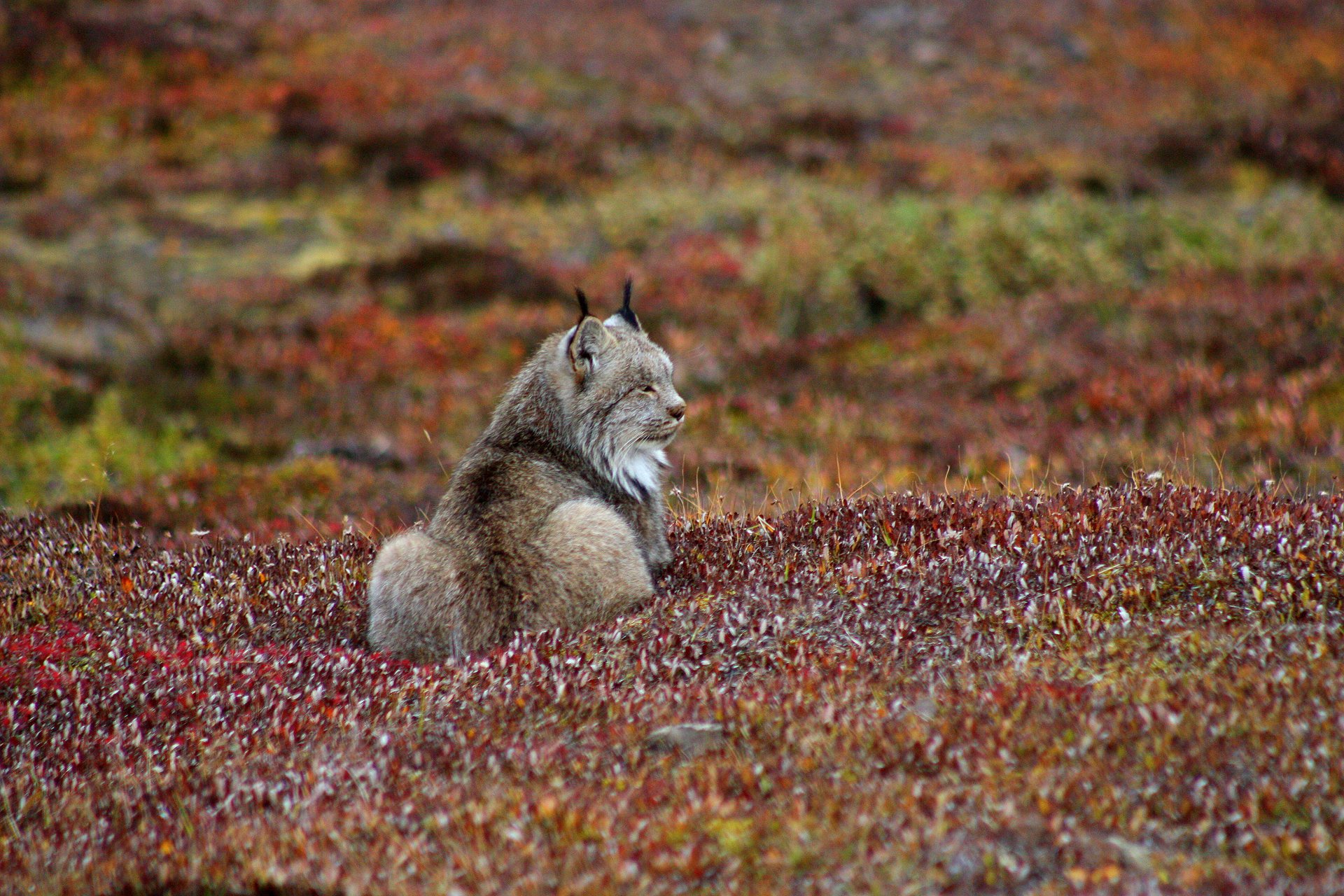
The most conspicuous fact about the snowshoe hare in the boreal forest is that its numbers oscillate. Populations rise over a period of years to a peak of extraordinary abundance, then crash to scarcity in a single summer, with cycle peaks separated by roughly ten years. The Hudson's Bay Company fur records — the longest continuous population dataset in North American ecology — show this oscillation with remarkable regularity, period of about ten years, and reveal that the lynx, a specialist predator of hares, oscillates on the same period with a lag of one to two years behind the hare (Fryxell, Sinclair, and Caughley 2014; ADFG 2025). In interior Alaska, Chapin et al. (2006) place hare peaks in 1961, 1971, 1981, 1990, and 1999, with lows in 1955, 1965, 1975, and 1993–1994 — a remarkably regular ten-year beat at the management-unit scale. Quantitatively, peak densities recorded at Wolff's Fairbanks sites in the 1970s ranged to the equivalent of about 5 hares per hectare; at Kluane in the southwest Yukon, Krebs and colleagues documented peaks at 2 hares per hectare in 1990 falling to 0.1 hares per hectare by 1993 — a twentyfold collapse in three years (Krebs et al. 2001, in [5]). The Bonanza Creek LTER near Fairbanks recorded peaks of 8.7 hares per hectare in the late 1990s (Flora 2002, in [5]). These quantitative anchors are from Kluane Yukon and Fairbanks — the closest well-instrumented sites to Denali in the catalog. Denali itself has no comparable long-term quantitative dataset.
The cycle propagates through the entire boreal carnivore community. Lynx populations follow hares with a one-to-two-year lag, with O'Donoghue et al. (1997, in Vaughan, Ryan, and Czaplewski 2015) documenting strong delayed numerical responses by both lynx and coyote at Kluane: predator populations increase severalfold one year after hare peaks, then collapse as hare density falls and pregnancy rates, litter sizes, and offspring survival all decline (Mowat et al. 1996, in Vaughan, Ryan, and Czaplewski 2015). The Alaska Department of Fish and Game documents lynx dispersal of 100 to 400 miles or more by radio-collared animals leaving areas where hares have crashed — one Yukon lynx walked over 400 miles to Chalkyitsik in the Yukon Flats (ADFG 2025). When hares are scarce, lynx fall back on grouse, ptarmigan, squirrels, and microtines, and during severe shortages will take prey well above their normal size class — caribou calves, Dall sheep, foxes (ADFG 2025). Murie (1962) documented exactly this fallback pattern in Denali during the 1954–1956 hare crash: scat analysis showed lynx supplementing rabbit with ptarmigan and ground squirrel, but the supplement was not enough to sustain the population, and lynx numbers collapsed in the years following. Larsen (1980) places the proportional lynx contribution to overwinter hare mortality at about 20% on average — significant but not by itself sufficient to drive the cycle. Beyond lynx, hare-dependent predators that also rise and crash include great horned owl, goshawk, marten, coyote, fox, and wolverine ([4]; [8] summarizing Adamcik and Keith 1978).
The mechanism that drives the crash, however, is unresolved — and the literature contains an open disagreement that has been substantive for forty years. [Conflict] The two leading hypotheses are that food (winter browse) sets the limit, with overbrowsing degrading both quantity and quality of woody forage to the point where hares cannot maintain body condition through winter; and that predation sets the limit, with the delayed numerical response of lynx and coyote driving hares to extinction-level mortality before food becomes the proximate constraint. Marchand (2014) lays out a third strand of the food argument involving plant chemical defense: when willows and birches are heavily browsed, they respond by producing juvenile shoots high in phenolic glycosides and other secondary metabolites that hares avoid, and these chemical defenses persist for two to three years after the browsing event — extending the food shortage well beyond the recovery of plant biomass and contributing a time lag that may explain the cycle's characteristic 8–11 year period. But Marchand also reports the contrary finding from the Kluane group led by A. R. E. Sinclair (Krebs and colleagues), who over more than a decade of work found no correlation between food chemical content and hare feeding preferences — hares ate plants containing the supposed defense compounds in rough proportion to availability. The Kluane group's resolution, formalized as the "predation-risk hypothesis," is that food is rarely uniformly limiting; rather, the threat of predation forces hares into safer but food-poor closed-cover habitats, so that as predators accumulate during peak and decline phases, hares progressively restrict themselves to refuges with worse forage, lose weight, drop their reproductive output, and experience chronically elevated stress hormones (Hik 1995; Krebs et al. 1995, in Vaughan, Ryan, and Czaplewski 2015). The widely accepted current synthesis is multifactor — predation, food, plant defense, parasites, and weather all contribute, with relative importance varying by site and cycle phase (Vaughan, Ryan, and Czaplewski 2015) — but the explicit weighting of food versus predation is unresolved. Sources do not agree on a single answer.
A further complication is the geographic scope of these data. Both Krebs's experimental work and the long Wolff time series come from sites — Kluane Yukon and Fairbanks Alaska — that are the closest well-instrumented analogues to Denali, but they are not Denali itself. Whether snowshoe hare cycles are even geographically synchronous is itself debated, with one analysis proposing a "traveling wave" originating in central Canada and propagating outward (Ranta et al. 1997, in [5]). The Alaska ADFG questionnaire data through the 1990s suggests peaks appear first in eastern Alaska and move westward over roughly six years [5]. The Denali quantitative pattern is best inferred from these adjacent records rather than measured directly.
What the Denali historical record does give is a long view of the cycle's qualitative behavior. Charles Sheldon spent the winter of 1907–08 at the north base of Denali and recorded what is, by the editor's reading of his observations, the bottom of a hare cycle: rabbits were at minimum, lynx were still numerous but in a starving condition, and the lynx had been driven to attack Dall sheep — Sheldon recorded two instances of lynx killing sheep, including one attack from ambush [6]. The editor's note that accompanies Sheldon's text (signed C. H. M.) draws out the temporal point that mattered to early-twentieth-century natural historians: lynx scarcity follows rabbit scarcity by about a year, because the year of greatest hare shortage still finds enfeebled lynx surviving but unable to breed, so their crash is recorded the next season. Murie (1962) documented the same cycle behavior firsthand at Denali in the mid-1950s: hares began to die in summer 1954, dropped sharply in 1955, and lynx — still scarce in 1955 but well-documented in his 1953–1956 scat collections — switched to ptarmigan and ground squirrel before themselves declining. The cycle has been a reliable feature of the Denali fauna across at least four documented generations of observers, from Sheldon through Murie to the contemporary ADFG management unit data.
4. Winter Survival: Foot, Coat, and Browse
The snowshoe hare's name is the answer to a specific physical problem: how to move at speed across deep, soft, unconsolidated boreal snow. Marchand (2014) frames this in terms of foot loading — body weight divided by the surface area of the feet. The snowshoe hare, like the lynx that hunts it, has a foot-surface-to-body-weight ratio that allows it to remain on top of the snowpack rather than sinking through. ADFG's track-curriculum estimate puts the snowshoe hare's foot loading at 0.17 pounds per square inch — about an eighth of a house cat's 1.42 psi — making the hare among the best northern snow floaters, in the same league as willow ptarmigan, which puts on its own snowshoes each fall by growing extra feather coverage on toes that themselves elongate (ADFG 2025 tracks curriculum). The structural detail is the long, broad, well-furred hind foot with widely spreading toes; in the foot family (Leporidae) the hind feet are much larger than the front and normally land in front of the forefeet in the bounding gait that is the species' typical movement pattern. The runways established summer-to-winter (§2) become floating tracks on the snowpack rather than sunken trenches because the animal's loading is light enough that it does not break through.
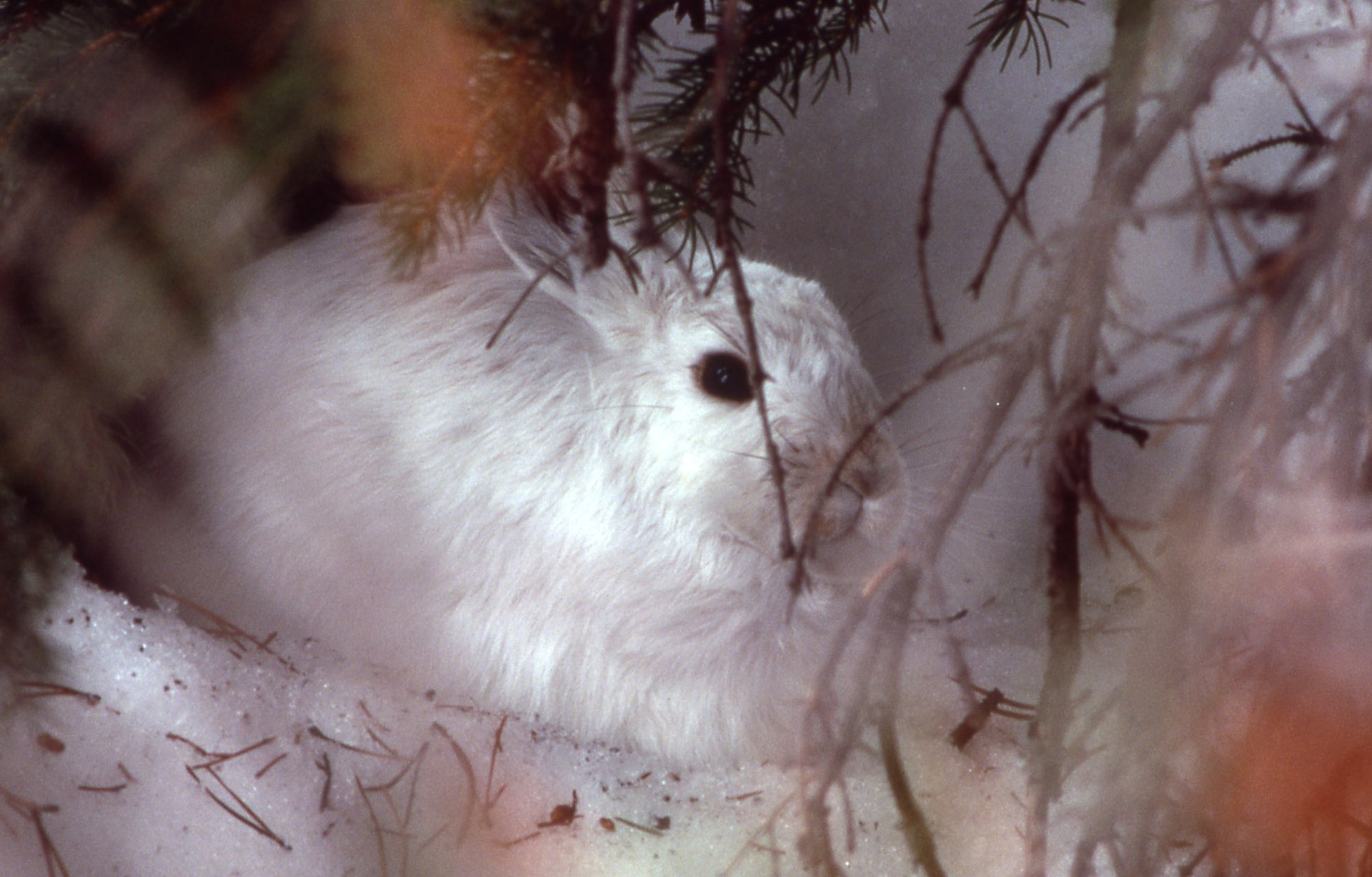
The coat changes twice a year between a summer pelage and a winter pelage, a pattern that ADFG describes as "varying" — the alternate common name "varying hare" refers to this. Summer coat is yellowish to grayish brown above with white underparts (ADFG 2025; [4]); winter coat is white above with the hairs dusky at the base and the underfur gray, leaving the ear-tips conspicuously black year-round (ADFG 2025). The behavioral logic of the change, as Murie put it, is that the coat "blends at all seasons with his background, so all he need do to be fairly sure of escaping visual detection is to have confidence in his camouflage and sit motionless" [4]. The pelage also serves a thermal function — Murie notes the winter fur is "so long, thick, and warm that he can sit all day in fifty below zero weather without freezing." In Vaughan, Ryan, and Czaplewski's general mammalogy treatment of seasonal molt, north-temperate species typically molt twice a year, with the winter pelage longer and more insulating than the summer one; in species that live where snow cover is continuous through winter, the summer coat is brown and the winter coat white, a pattern shared with arctic fox, several hares and rodents, and some weasels (Vaughan, Ryan, and Czaplewski 2015). The molt is photoperiod-driven [General knowledge, high confidence] — the timing is set by day length rather than by the actual arrival of snow — and Murie's reference to the species' brown year-round coat in low-snow areas of Washington indicates the trait has a geographic pattern reflecting selection by snow regime rather than a fixed obligate behavior. The catalog does not contain the quantitative coat-color-mismatch literature that has become a major focus of recent climate-change work on the species; [Not in sources] the question of whether warming and shorter snow seasons in Alaska are pushing snowshoe hare camouflage out of phase with snowpack is not addressed in the routed sources, though it is a well-known concern in the broader literature.
Winter forage is the secondary survival problem. With herbaceous plants buried under snow, the hare shifts to woody twigs, buds, and bark — willow, aspen, dwarf birch, and alder at the top of the preference order; spruce and other conifers low on the list ([8]; ADFG 2025; [4]). The animal high-grades within twigs, taking bark and cambium (the digestible portion) and discarding the relatively indigestible wood — its dentition and dexterity permit this kind of selective use of woody material that moose, which swallow the entire stem, cannot achieve [5]. In high-density years the impact on browse is conspicuous: large willow and dwarf birch are trimmed to the snow line and the bark stripped in a band 2 feet wide at the snow surface [4]; ADFG notes that hares may kill brush by overbrowsing during peak years and compete with moose for forage.
The plant defense problem is substantial. Snowshoe hares share their winter range with woody plants — chiefly willows and birches — that have evolved chemical defenses against the same browsing pressure that has shaped the hares for at least the eight-to-eleven-year periodicity of their cycle. Marchand (2014) documents the experimental evidence: when concentrations of phenolic glycosides extracted from willow bark were applied to commercial rabbit chow in feeding trials, even captive snowshoe hares preferred untreated food, and at high enough concentrations of defense compounds captive hares eventually stopped eating entirely. The chemical defenses are induced — willows and birches respond to heavy browsing by producing juvenile shoots with strong defenses, maintained for two to three years ([3], after Bryant and others). This creates a time lag in food-quality recovery that extends well beyond the recovery of plant biomass alone. Reciprocal feeding experiments between Alaskan and Finnish hares and shrubs (Bryant et al. 1989, in [3]) found that Alaskan birch and willow have the highest defense compound concentrations and that Alaskan hares show the greatest tolerance for those compounds — consistent with longer and more intensive coevolution between the species. The paradox Marchand notes is that hares often select food with high resin concentrations anyway, because those plants sometimes have higher overall digestibility than less-defended options. The browsing decision in winter is a continuous balancing of energy gain, nitrogen content, and tolerable concentration of defense compounds, with no single plant species satisfying all constraints.
Behaviorally, hares are crepuscular — most active at dusk and dawn — and rely on inactivity and camouflage during the brightest part of the day (ADFG 2025). They do not migrate, do not cache food, and do not occupy burrows. Survival through an Alaskan winter rests on the combination of physical adaptations (foot loading, insulating pelage, white camouflage) and the ability to extract enough nourishment from chemically defended woody twigs to maintain body condition until spring. Hares rarely live more than two winters [5] — the species' population strategy is not individual longevity but the rapid generational turnover that allows three litters per breeding female per year to flood the system with new cohorts during the build phase of the cycle.
5. Fire, Succession, and the Hare-Lynx Habitat Chain
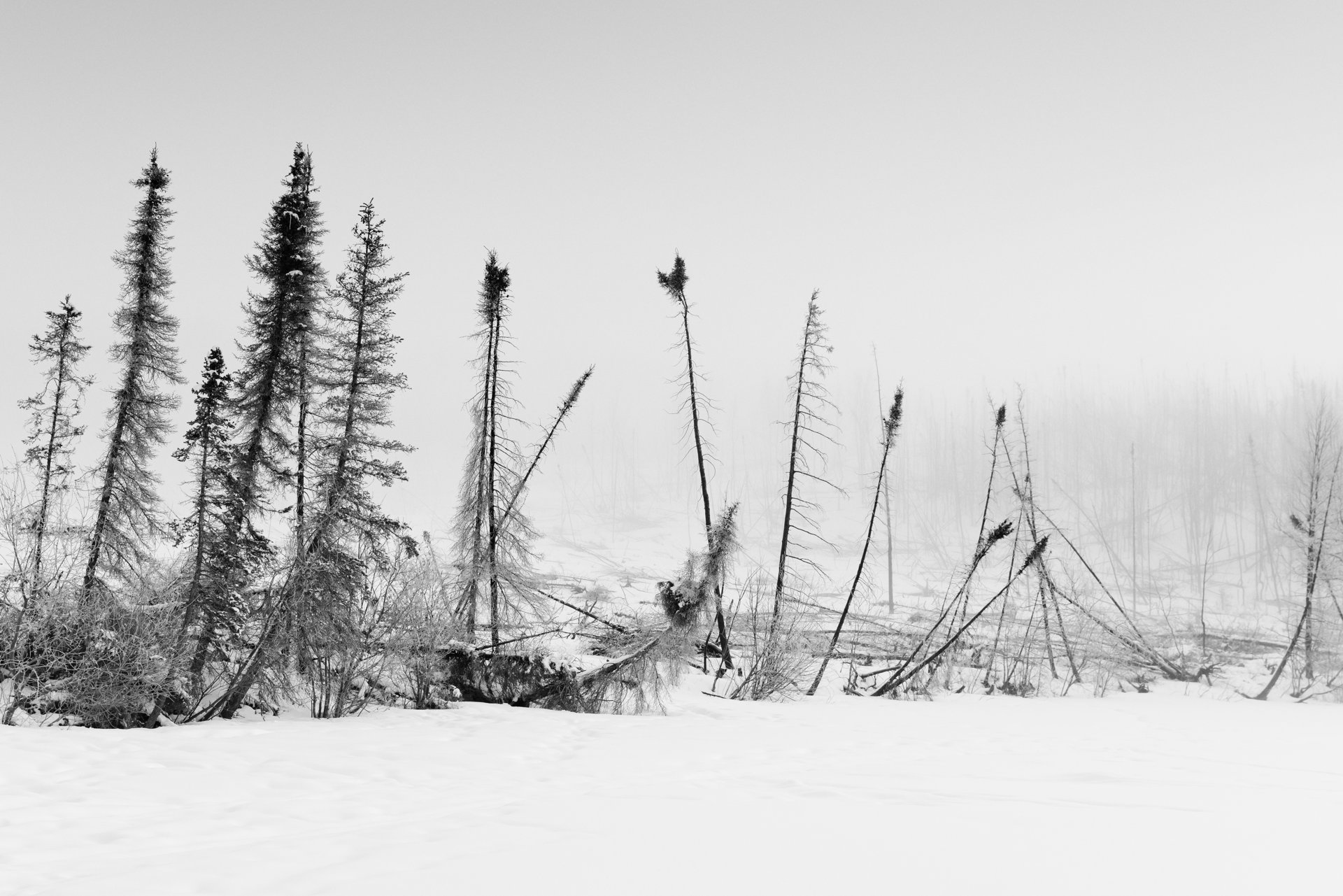
Fire in the interior Alaskan boreal forest is not a disturbance superimposed on a stable system — it is the dominant successional driver, recurring on intervals of 36 years in black spruce forests to 113 years in white spruce forests (Yarie 1981, in [5]). The vegetation that follows fire — early-successional willow, aspen, birch, alder — is exactly the woody forage on which snowshoe hares depend through winter (§§2, 4). The hare's habitat is therefore a continuously renewing post-disturbance mosaic, and the lynx's habitat is the hare's habitat. Viereck and Schandelmeier (1980) make the chain explicit: while no direct information is available on the interaction of fire with lynx, "the well-established snowshoe hare-lynx cycle indicates that what is good for the snowshoe hare is good for the lynx. Thus, the evidence reported in the snowshoe hare section of this report indicates that fire should have a positive effect on lynx populations by increasing the supply of their main food source, snowshoe hares."
The mechanism runs through plant succession. A stand-replacing fire opens the canopy and removes the litter layer; in the years after, aspen, paper birch, and willow regenerate from seed and root sucker, alongside herbaceous flush growth on the open ground. By Wolff's observation in interior Alaska, hares move into recently burned areas during population peaks because of the abundance of browse, even though cover is initially thin and predation exposure higher than in mature forest (Wolff 1977, in [7]). The browse productivity of a young burn is substantial: in Alberta studies cited in the same source, hare populations actually built more rapidly in burned areas after the second post-fire summer than in unburned forest, despite the temporary period of habitat unsuitability during the fire and the first year after. The young deciduous forest stage that follows fire is, ecologically speaking, the productive hare landscape — the closed mature conifer forest that eventually returns is comparatively poor habitat. Larsen captures the food side directly: "herbage within reach of a hare is in short supply in a late-successional stage forest but is very abundant soon after fire or logging" [8].
This pattern carries through to lynx demography. ADFG's lynx species account is explicit: "the best lynx habitat in Alaska occurs where fires or other factors create and maintain a mixture of vegetation types with an abundance of early successional growth. This provides the best habitat for snowshoe hares and other small prey of lynx" (ADFG 2025). The fire-driven mosaic that supports peak hare populations also supports peak lynx populations a year or two later. The chain is at least three steps long: fire opens canopy and resets succession; deciduous regrowth produces the willow–aspen–birch–alder browse that supports high hare densities a decade or two post-fire; high hare densities support high lynx (and coyote, marten, owl, hawk) densities with a lag of one to two years. Lynx kitten production and survival are tightly coupled to hare abundance (ADFG 2025), so the demographic effect of a productive post-fire patch reaches into lynx reproductive success rather than just adult lynx movement.
Fox (1978) extended this logic into a strong-form hypothesis: the snowshoe hare-lynx cycle itself is not a predator-prey or herbivore-vegetation oscillation but a forced oscillation driven by the period of forest fire frequencies across northern North America. Fox's argument — laid out in the boreal mammalogy and fire-ecology literature [8]; [7]; [5] — is that the cyclic regional pattern of fires generates a corresponding cyclic pattern of post-fire habitat suitability, which in turn produces the regular ten-year oscillation in hare numbers and the lynx response. Viereck and Schandelmeier accept the framework as interesting but note that "there are few if any biological data to support it" beyond Fox's correlational analysis of fire-frequency and lynx-pelt records. Chapin et al. (2006) report Fox's empirical finding that aerial extent of area burned by fire was a good predictor of lynx pelts coming to market, and hence of snowshoe hare populations — a strong correlation, though not by itself proof that fire drives the hare cycle rather than the reverse, and not addressing the conventional within-stand mechanisms of food limitation, plant defense, and predation discussed in §3.
What is more solid in the catalog is the long-term significance of fire to the spatial structure of the hare-lynx system rather than its temporal periodicity. The fire-driven habitat mosaic — patches of dense black spruce and willow–alder thicket interspersed with recent burns of varying age — is what makes a given landscape suitable for hare in the first place (Wolff in [7]), and the productivity of any given hare population reflects how much of that mosaic is in the 10-to-30-year-post-fire stage when deciduous browse peaks. A landscape that has not burned in 100 years is a landscape with relatively few hares; a landscape with a recent fire mosaic is hare country. The ten-year cycle plays out on top of this longer-period spatial template, with cycle amplitude likely higher in productive post-fire landscapes than in mature unburned ones.
For Denali, this framework has direct application. The Denali landscape is a complex mosaic of recent burns, mid-successional birch-aspen-spruce stands, and mature white and black spruce, with willow–alder thickets along the major drainages. Murie's observation (§2) that the productive hare habitat in the park is concentrated along the brushy east and north boundaries is consistent with this spatial template: those are the lower-elevation areas most exposed to fire and to the willow–alder riparian corridors that produce the heaviest browse. The cycle still runs (§3) — and the lynx responds to it — but the spatial pattern of hare productivity within the park is set by the cumulative fire history of the previous several decades. Under a warming climate with increasing fire activity in interior Alaska (Kasischke et al. 2010, treated in the white spruce article), the long-period spatial template that supports the hare-lynx system is itself shifting, with consequences for both species that are not directly documented in the catalog for Denali specifically. The food-web architecture, however, is robust: fire makes deciduous browse, browse makes hares, hares make lynx, and what is good for one is good for the other.
Article-Level Inferences
This article uses the long-form accommodation in synthesis_rules_v1_3.md §3.8: Tier 4 inferences (causal, mechanistic, or temporal links the sources do not explicitly state) appear in the prose without inline [Inference] tags. They are listed here in plain language, and manifest_v1.yaml carries per-section source attribution including tier markers. Tier 5 (general knowledge, not in sources) tags remain inline per §3.8(4), as do [Conflict] flags.
-
Reproductive schedule as demographic engine (§1). The article frames the snowshoe hare's three-litters-per-year reproductive schedule, with first-year breeding, as the demographic engine that drives the species' capacity for rapid population growth and the peak densities of 600 animals per square mile. ADFG reports the schedule, the litter sizes, and the peak densities separately; the explicit causal link — that these reproductive parameters mechanistically explain the cycle amplitude — is the article's inference.
-
Cover-versus-browse seasonal trade-off as the logic of Wolff's habitat use pattern (§2). Wolff documents that hares concentrate in dense black spruce and willow–alder during lows and disperse into burns during highs. The article frames this as a trade-off between cover (priority when rare and conspicuous) and browse (priority when food competition matters), with predation risk and food availability acting as the two sides. Wolff describes the pattern; the cover-versus-browse trade-off framing as causal explanation is the article's.
-
Geographic-scope generalization from Kluane / Fairbanks to Denali (§3). The article extends quantitative cycle parameters from Wolff's Fairbanks work and Krebs's Kluane Yukon work to "the closest quantitative regime to Denali documented in the catalog" — explicitly flagged inline as a scope generalization, but the generalization itself is the article's, not the original sources'. The original studies make no claim about Denali specifically; the article uses them as the best available proxy with appropriate hedging.
-
Editor's interpretation of Sheldon as a cycle-bottom observation (§3). Sheldon's 1907–08 winter observations describe rabbit scarcity, starving lynx, and lynx switching to sheep; the editorial note signed C. H. M. interprets these as the year of greatest rabbit scarcity with a lagged lynx crash to follow. The article adopts this interpretation as Denali's historical record of a cycle bottom, treating the editor's framing as broadly correct. The interpretation is the editor's; the article's claim that this is the historical Denali signal of the cycle is the article's.
-
Fire–succession–browse–hare–lynx as a multi-step temporal chain (§5). Viereck and Schandelmeier draw the two-step chain "good for the snowshoe hare is good for the lynx." Chapin et al. document Fox's fire–lynx-pelt correlation. The article assembles these into an explicit four-link causal chain (fire → deciduous regeneration → hare density → lynx demography with one-to-two-year lag) and applies this template to interpret Murie's regional pattern in Denali — concentration of productive hare habitat at the lower elevations exposed to fire and riparian corridors. Each individual link is documented; the assembled chain and its Denali application are the article's inference.
-
Spatial-template-versus-temporal-cycle framing (§5). The article frames the fire-driven habitat mosaic as a spatial template on which the temporal cycle runs, with cycle amplitude likely higher in productive post-fire landscapes than mature unburned ones, and projects under climate-driven fire-regime change that the spatial template itself is shifting. Fox (1978) proposes fire as the temporal driver; Wolff and Larsen describe the within-landscape mosaic structure; Kasischke documents the changing fire regime. The two-time-scale framing (long spatial template, decadal temporal cycle, both interacting under climate change) is the article's synthesis, not directly stated in any single source.
Coverage Gaps and Currency Notes
- Quantitative cycle data for Denali specifically is [not in sources]. All quantitative regimes (Krebs at Kluane Yukon; Wolff and Bonanza Creek LTER near Fairbanks) are extrapolated to Denali in §3 with explicit scope flags. A long-term Denali hare-density dataset would close this gap.
- Climate-change-driven coat-color mismatch is [not in sources] — see §4. The Mills lab work (Mills et al. 2013, PNAS) and related literature on phenology of the molt vs snow arrival under warming is not in the routed catalog. Phase 1 flagged this as a high-profile follow-up intake.
- Athabaskan / Koyukon hare hunting and traditional use is [not in sources]. Hares are an important subsistence resource for Alaska Natives historically and contemporarily (ADFG 2025 references them as "an important source of food for Alaskans") but no ethnographic source in the routed catalog treats the subject for the Denali region.
- Detailed parasitology, especially tularemia, is [not in sources]. ADFG mentions tularemia signs and handling precautions; no dedicated parasitology source is routed.
- Spatial behavior detail — home range, dispersal, density-dependence at the individual level — is [not in sources]. Hodges, Krebs, and others have a large dedicated literature; only the population-scale results are in the catalog.
- Sheldon 1930 is a primary historical source but the cycle interpretation in §3 relies partly on the editor's note (C. H. M. — Charles Hart Merriam), which is itself a secondary reading of Sheldon's field observations. The interpretation appears sound but is editorial rather than directly Sheldon's.
- ADFG (2025) is current-as-of access date. Agency wildlife pages update routinely; any cited claim should be re-verified on each use.
- Pielou (1994) is not cited for snowshoe-specific claims because its hare treatment is Arctic hare (Lepus arcticus) rather than snowshoe — used in the Overview only as a Leporidae contrast in the catalog originally, dropped from body sections per Phase 1 caveats.
Sources
Alaska Department of Fish and Game 2025; Chapin et al. 2006; Fryxell, Sinclair, and Caughley 2014; Larsen 1980; MacDonald and Cook 2009; Marchand 2014; Murie 1962; Sheldon 1930; Vaughan, Ryan, and Czaplewski 2015; Viereck and Schandelmeier 1980.
(Per synthesis_rules_v1_3.md §2, the citation manifest at manifest_v1.yaml is the authoritative per-paragraph attribution record; this Sources line is a reader convenience.)
References
- ^ MacDonald & Cook 2009. Recent Mammals of Alaska.
- ^ Department of Fish and Game 2025. ADFG Wildlife Notebook Series — Denali-Relevant Species Selection (merged).
- ^ Marchand 2014. Life in the Cold: An Introduction to Winter Ecology.
- ^ Murie 1962. The Mammals of Mount McKinley.
- ^ Stuart Chapin III et al. 2006. Alaska's Changing Boreal Forest.
- ^ Sheldon 1930. The Wilderness of Denali.
- ^ Viereck & Schandelmeier 1980. Effects of Fire in Alaska and Adjacent Canada: A Literature Review.
- ^ Larsen 1980. The Boreal Ecosystem.
- ^ Fryxell et al. 2014. Wildlife Ecology, Conservation, and Management.
- ^ Vaughan et al. 2015. Mammalogy: Adaptation, Diversity, Ecology.
- ^ Department of Fish and Game, Division of Wildlife Conservation 2025. Tracks of Alaska Animals: A Guide for Educators.